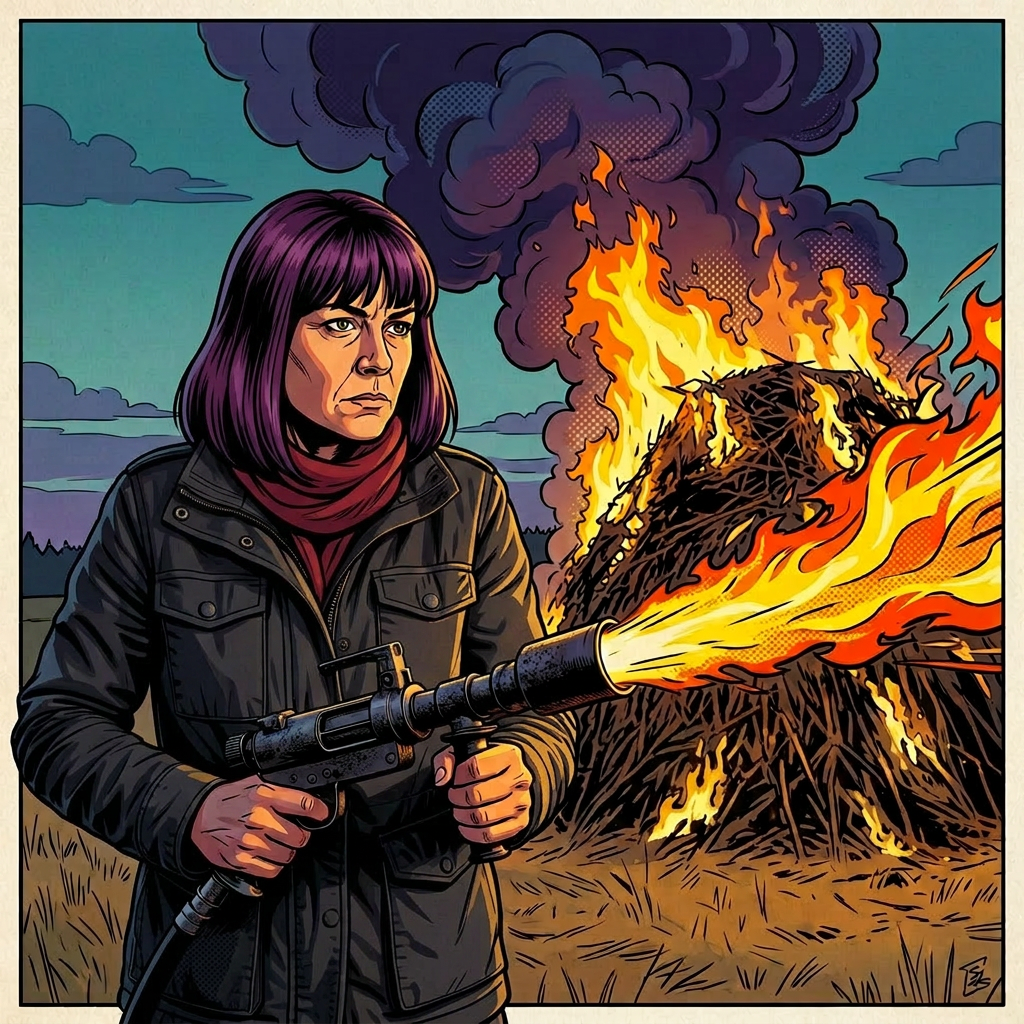
I burned the haystack before it had a name — and wrote a play about it.
There’s a viral dating method sweeping the internet right now called the “burned haystack.” The premise is elegant in its ruthlessness: if you’re looking for a needle in a haystack, the most efficient strategy isn’t to sort through every piece of hay. You burn the whole thing to the ground and let the needle reveal itself, because the needle won’t burn.
I read about it last week and felt something shift in my chest — the particular recognition of someone who has lived a thing before it had a name.
In February 2018, I went on ten first dates in one month. I made a deal-breaker list. I set a one-hour time limit per date, two at the absolute most. I downloaded Bumble because it had a women-first policy and that small gesture of control felt important. I blocked jerks without guilt. I trusted my instincts with a ferocity I hadn’t felt in years — not because I had read a book about feminist rhetoric, but because I had run out of the energy required to override them.
I was, without knowing it, burning the haystack.
To understand why that mattered, you need to understand what the years before it had looked like.
In 2012, a man I trusted assaulted me, which is the kind of rape that takes nine different sexual assault specialists to convince you is actually rape, because the world has spent considerable effort teaching women to doubt themselves in exactly this situation. The aftermath was years of complex PTSD, of a nervous system that had learned to treat ordinary interactions as potential threats, of a voice inside me that said something’s wrong here and a lifetime of conditioning that said don’t be difficult, give him a chance, you’re probably overreacting.
A year later, my husband had a serious accident at work. He survived, but the brain injury that followed changed him in ways that were quiet and incremental and devastating — like a favourite song played in a slightly wrong key until one day you realise you’ve stopped recognising it. In 2015, after fifteen years, he left. He said he had been pretending to be someone else for most of our marriage, which is a sentence that takes a very long time to metabolize.
What followed were three years of rebuilding — or more accurately, of digging myself out of a grave. I tried to find out who I was without the shape the marriage had given my days, without the voice that had drowned out my own. I travelled extensively, pet sitting my way across Britain and Europe, living in borrowed spaces with other people’s beloved animals, doing the slow unglamorous work of learning to trust my own perceptions again.
By 2018, I was ready (or ready enough, which is the only kind of ready that actually exists). This difficult period in my life is more fully explored in my memoir One Reason to Live.
The burned haystack method, as Jennie Young — a professor of rhetoric and women’s studies at the University of Wisconsin — explains it, is fundamentally about trusting what people are telling you through their language and their behavior, rather than overriding your instincts for the sake of being polite. It teaches women to identify red flag patterns in dating profiles and messages, to block without guilt, to refuse the exhausting cultural instruction to give everyone a chance. Young developed it after her own divorce, when she found herself shocked by how normalised manipulative communication had become in online dating.
What strikes me, reading about her method now, is how much of what she has systematised and published — with academic rigour and sharp humour — I arrived at instinctively and desperately, in a notebook, in February 2018, because I had been so thoroughly trained not to trust myself that the only way back was to create my own rules and follow them without exception.
My deal-breaker list was not elegant. It was written in a bullet journal at my host’s kitchen table, and it grew longer with every date. But it was doing exactly what Young describes: identifying, in advance, the things I already knew I didn’t want, so that when I encountered them in person I couldn’t talk myself out of seeing them clearly.
- The man who made a joke about #MeToo.
- The one who tried to talk me out of a no.
- The one who invaded my personal space in a way that made my skin crawl.
- The one who described his ex-wife as “crazy” and “psycho.”
With each interaction, something recalibrated. The voice that said leave got louder. The trust came back.
The point is learning to trust the burning — the slow, careful, sometimes frightening process of learning to hear one’s own voice again. Of understanding that discomfort is data. That leaving is not rudeness—it’s self-respect. That the needle, if it exists, will reveal itself precisely because you stopped sorting desperately through hay that was never going to be worth your time.
Last month, my play 10 First Dates—based these ten dates—had its world premiere at London’s Etcetera Theatre in Camden as part of the Women Writers Festival. It received four-star reviews and two award nominations. Every night after the show, women came up to tell me they had dated every single man in the play — that they recognized themselves in Maggie, navigating the same exhausting, occasionally dangerous, occasionally wonderful landscape.
The burned haystack method has a quarter of a million members in its Facebook community and a brand new book from HarperCollins.
My play ran for five nights in a forty-seat fringe venue in Camden.
The cultural scale is obviously different, but we are describing the same thing — the same hard-won understanding that so many women arrive at eventually, through therapy or instinct or desperation or experience: that your time and your safety and your nervous system are not infinite resources to be dispersed generously among every man who wants your attention.
You are the needle. Act accordingly.
 Christine Rose
Leave a comment