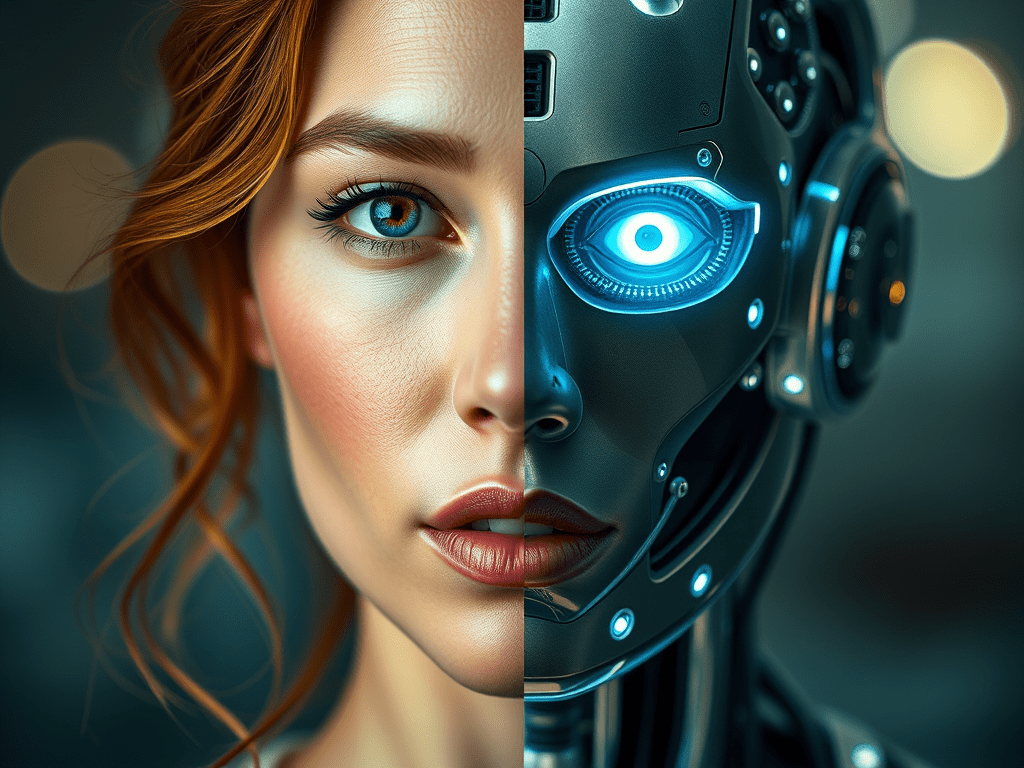
As with many writers around the world—from creative to academic to technical writing—AI is at the forefront of our minds. Polarized opinions fill comment sections across social networks and news sites, debating whether AI signals the end of creativity and the need for human writers, or if it’s a useful tool for research and/or to stave off writer’s block. I tend to fall into the latter category because:
- AI is fun to play with (made this image with WordPress’s built-in AI).
- AI makes research take seconds rather than hours.
- AI is great for brainstorming and analysis.
- AI eliminates blank-page syndrome and cuts through writers block.
Of course, AI-generated content is quite often incorrect, so it must be thoroughly fact-checked. Also, it usually shows me what I don’t want rather than what I do want, but that’s perfect for my writing process! It gives me a place to start—which is often the hardest part—and from there I can run with a concept or idea, take or dismiss research, and explore choices in much less time and with so much less frustration than sitting at my keyboard for hours waiting for inspiration to strike.
Last week, I even used AI for analysis while writing a new play, which proved very helpful indeed. I loved the opening monologue. It flowed well and had a humorous tone, but something just didn’t feel right with the subsequent scenes. They were too dark, too serious, too disjointed somehow. I wasn’t confident it was going in the right direction, so I emailed it to a friend for feedback. Problem was…I was in the zone right then! I didn’t want to wait for days or longer. I wanted feedback immediately so I could fix it. ChatGPT analyzed the entire play in seconds. It pointed out where the tonal shifts occurred, explained why it wasn’t working, and provided suggestions on how to make the scenes more interesting and consistent in tone. It enabled me to revisit the script with renewed inspiration, and the dialogue just flowed out of me, as it so often does when I write plays.
This is the way I love to use AI—as a writing tool, just another in my ever-growing writer toolbox. Still, with these endless articles on AI and what it means for creatives, academics, and professionals (not to mention hearing stories of completely AI written books published on Amazon by the hundreds every day), I was curious to learn more about how people were detecting AI-generated content, especially in an academic setting. (One of my characters is a college professor lamenting the modern student’s use of AI to write essays.)
So I decided to do a few experiments.
Moments ago I wrote this new Playwright page. It took me maybe 15 minutes to compose this simple page that doesn’t even contain much information, but when I put it through an AI Detector, the analysis came back as 44% AI-generated!
When I fed it through Humanize AI and analyzed it again, it came back as 0% AI-generated. The difference? Strangely minimal. A few sentences in the “humanized” version are longer, use simpler words, and are frankly not as well constructed.
For example, my original sentence: “Perhaps because she’s so loquacious, she’s found that she has a natural talent for dialogue and thoroughly enjoys writing plays!” has been “humanized” to say: “Perhaps because she is so verbose, she’s found she has a natural ear for dialogue and absolutely loves writing plays!”
How is the first (written by a human) deemed AI-generated and the second (AI-generated) deemed 100% written by a human?
In a second example, my original sentence: “Utilizing the skills of LPW’s talented dramaturg Kimberly Andrews, Christine revised and polished these plays in preparation for submissions and ultimately staging” has been “humanized” to read: “By hiring the talents of LPW’s own talented dramaturg Kimberly Andrews, Christine rewrote and polished these plays in preparation for submissions and, eventually, productions.”
Very little difference between these examples, yet the AI Detector says both my original sentences are AI-generated but the AI-humanized conversions are 100% human. Go figure!
Most writers know that the bulk of composition is done in revisions—not in drafting. When I revise my own or others’ work, I tighten syntax, fix grammar and punctuation, use the active voice when possible, change repetitive words, and vary sentence structure. With this in mind, I did a second experiment. First, I had ChatGPT generate a paragraph on the benefits and detriments of AI:
AI can significantly enhance the writing process by providing instant feedback, generating ideas, and streamlining tedious tasks like editing and formatting. It can assist writers in overcoming writer’s block by suggesting content, improving language and grammar, and tailoring writing to specific audiences or tones. AI’s ability to analyze large datasets also allows for more informed decision-making, enabling writers to craft content that resonates with readers and meets market demands efficiently. However, relying on AI for writing can diminish creativity and lead to homogenized content, as AI-generated text often lacks the nuance and emotional depth of human writing.
When I ran the above through the AI-Detector, it came back at 100% AI-generated. Fair, because it totally was. Then I ran it through Humanize AI and got the following:
AI will, no doubt, make the process of writing easy by allowing instantaneous feedback and ideation, and automation of tasks that may be irksome for a writer to do himself, like editing and formatting. It can help writers get themselves out of such dilemmas as writer’s block by suggesting content for them, improving language and grammar, and even suggesting how to write for particular audiences or tones. AI also helps in analyzing large datasets of information, thus feeding into better-informed decisions on writing contents that appeal more to readers and answer the needs of the market in shorter periods of time. But relying on AI in writing will reduce the creativity and individuality of a writer; lots of the contents would appear to be similar. This is because there are subtle elements in human writing, such as nuance and emotional depth, which AI is incapable of providing.
When fed into the AI-Detector, it resulted in 0% AI-generated. The sentences are much more convoluted and in some cases contain incorrect punctuation.
Now, I’ll revise this “humanized” version using my aforementioned revision skills:
AI can make the writing process easier by providing instantaneous feedback, generating ideas, and automating tedious tasks like editing and formatting. It can help writers avoid writer’s block by suggesting content, improving language and grammar, and even adjusting tone and style for particular audiences. AI can also analyze large datasets of information, enabling the user to make better-informed decisions, appeal more to readers, and address market needs. However, a reliance on AI for writing could reduce a writer’s creativity and individuality because content might appear too similar. AI cannot effectively replicate subtle elements in human writing, such as nuance and emotional depth.
These revisions—mostly tightening syntax and using active voice—now result in a 57% likelihood it was AI-generated. Although in this case it might be true since the original paragraph and the humanized one were both AI-generated, it’s important to remember that the humanized one I revised here was analyzed at 0% AI-generated before I made those relatively few changes.
Could it be that well-written content can be mistaken for AI-generated content? Medium published an article on this in September 2023 and another in October 2023. Maybe AI-detectors are trained to analyze the writing of the average human. Remember that the average American reads below at 7th grade level—that’s 12 years old—so if someone has extensively studied English and composition, knows grammar rules, and has college- (or even high-school-) level writing skills, perhaps the AI-detector has a more difficult time parsing whether the writing is human- or AI-generated.
(That said, this entire post was deemed 0% AI-generated, despite my credentials and the parts that are literally AI-generated. However, if I get ChatGPT to proofread it for spelling / usage errors, it then comes back at 34% AI-generated—with 0% AI-refined! Is there any rhyme or reason to it?)
Food for thought!

 Christine Rose
Leave a reply to ljones1966 Cancel reply