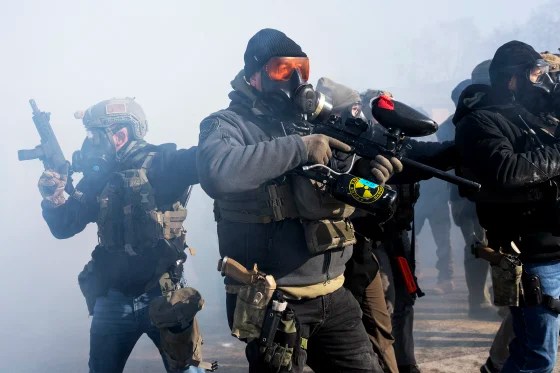
What if the very reasons our ancestors felt compelled to revolt — the list of abuses against basic rights and liberties — weren’t just history but a remarkably accurate lens for how power is being wielded in America today?
That’s the argument made in a powerful video I’m sharing below. The speaker doesn’t just quote from the Declaration of Independence — he connects its specific complaints against King George III to actions, policies, and state behavior in modern America. Watching it will take some courage, because the parallels are stark and unlikely to make polite dinner conversation.
📽️ Watch the video here, starting at the point he begins talking about this:
Below is an argument grounded in our founding documents — not fearmongering, but a serious comparison between the text of America’s foundational grievance list and what’s unfolding now.
What the Founders Listed — and What It Meant
The Declaration of Independence laid out the reasons the American colonies believed they were justified in declaring independence from British rule.
The bulk of the Declaration is a list of grievances against King George III, meant to prove he had repeatedly violated fundamental rights and laws. Among them were accusations that he:
- Kept standing armies among the people in peacetime without the consent of legislatures.
- Made the military independent of and superior to civil power.
- Quartered armed troops among the populace.
- Protected those troops from punishment for killing inhabitants.
- Cut off trade with the world.
- Imposed taxes without consent.
- Deprived colonists of trial by jury.
- Transported people abroad for “pretended offenses.”
These weren’t abstract claims — they were legal and political charges meant to justify a revolution.
Let’s begin with King George III’s use of military force on American soil without consent:
“He has kept among us, in times of peace, standing armies without the consent of our legislatures…” — Declaration of Independence
That charge was not about metaphor — it was about armed forces being used against civilians who had not consented to them and without any civil oversight. Today, a similar pattern has emerged around Immigration and Customs Enforcement (ICE) deployments — not at a distant border, but deep in American cities such as Minneapolis, Chicago, and Portland.
Across Minnesota, thousands of ICE agents and other federal officers have been sent in under a massive operation dubbed “Operation Metro Surge.” Local officials there — including the Cities of Minneapolis and St. Paul and the Minnesota Attorney General — have sued the Department of Homeland Security, arguing that these deployments amount to unconstitutional federal overreach and violate the Tenth Amendment by commandeering state resources and disrupting civic life without local consent.
The protests that have followed are not fringe events — they are mass demonstrations in response to escalating federal enforcement actions that many residents and local leaders characterize as harassment, dangerous, and unlawful.
Moreover, these confrontations have at times turned deadly. The fatal shooting of 37-year-old Renée Good by a federal ICE agent in Minneapolis on January 7, 2026 triggered widespread protests and legal challenges. Just weeks later, on January 24, 2026, federal immigration agents murdered Alex Pretti, a 37-year-old Minneapolis resident and VA nurse who was acting as a legal observer during protests. Multiple news reports and video evidence contradicted federal claims that Pretti was a threat; instead, he was trying to help others and was murdered while restrained on the ground—10 rounds shot into his back.
These deaths, both carried out by armed federal agents operating in a city far from any border conflict, sparked an intense public outcry and raised urgent questions about the use of deadly force by federal agents on U.S. soil.
Over the same period, similar tensions have played out in Portland, Oregon, where federal agents — including ICE officers — have deployed tear gas, flash-bangs, and other crowd-control munitions against peaceful protesters outside an ICE processing center. Many of those marching were families and union members, and witnesses described federal response tactics that struck children and bystanders with chemical agents and projectiles, prompting outcry from local officials and residents alike.
Portland’s mayor has publicly condemned those actions as “violent and unconstitutional,” calling on ICE to withdraw from the city and criticizing the federal government for endangering civilians — especially young people — under the guise of protecting federal property.
Civil liberties organizations have also taken legal action. The ACLU of Oregon and allied attorneys are pressing a federal judge to impose constraints on federal agents’ use of force — arguing that peaceful protest is a constitutional right, and that indiscriminate crowd-control tactics against nonviolent demonstrators violate the First Amendment.
Taken together, these events raise serious questions about the deployment of federal police powers in civilian communities without meaningful consent or oversight — questions that echo the founders’ complaint about standing armies, quartering of troops, and violence against civilians.
To many observers — including protesters, city leaders, and civil liberties advocates — the scenes in Minneapolis and Portland are not isolated enforcement actions but a pattern that blurs the line between domestic law enforcement and militarized force.
That blurring was precisely what our ancestors rose up against in 1776, when they wrote that government power should be accountable to the people, not unconstrained and imposed from above.
What Our Rights Really Say
The Bill of Rights — ratified fifteen years after the Declaration — enshrined specific protections meant to safeguard freedoms against precisely the kinds of abuses the founders feared. For example:
First Amendment:
“Congress shall make no law … abridging the freedom of speech, or of the press; or the right of the people peaceably to assemble, and to petition the Government for a redress of grievances.”
Second Amendment:
“The right of the people to keep and bear Arms, shall not be infringed.”
Fourth Amendment:
These amendments reflect the colonists’ complaints about abusive government power — and they are meant to be more than words on paper.
When Founding Principles Meet Current Events
Here are real-world instances that mirror the kinds of grievances the Declaration of Independence and the Bill of Rights were written to prevent:
✔ Suppression or Intimidation of Protest and the Press
Civil liberties groups warn that federal action during protests — including heavy-handed tactics against peaceful demonstrators, arrests of journalists, and militarized law enforcement deployments — raises serious First Amendment concerns.
✔ Federal Agents and Military on Domestic Streets
Courts have found that deployments of National Guard and federal troops in places like Minneapolis and Portland — to quell protests or protect facilities — lack solid constitutional justification, echoing the founders’ complaint about standing armies without consent.
✔ Warrantless Searches and Seizure
Whistleblower complaints and lawsuits have brought attention to internal memoranda giving immigration agents broad authority to enter homes based on administrative warrants — a move many legal experts argue violates the Fourth Amendment.
✔ Gun Rights Debates and Second Amendment Conflict
While the administration touts protecting Second Amendment rights, ongoing controversies — including federal lawsuits, conflicting interpretations of concealed-carry enforcement, and tragic shooting incidents involving federal agents — underscore deep national divisions over how the right to bear arms is actually honored or interpreted.
✔ Blocking Oversight and Transparency
Members of Congress have sued the administration for blocking lawful oversight of immigration detention facilities — a move critics say undermines accountability and violates legislative checks and balances.
Why This Matters
The founders didn’t claim tyranny could only come from a distant king; they warned that governments can become tyrannical when they override the law and trample the rights of the people. The Declaration’s list of grievances was meant to prove that this had happened — and to justify the colonists’ decision to resist.
Today, many Americans of all political stripes are alarmed that constitutional protections — from free speech to protection against unreasonable searches to impeding investigations — are being tested in ways that echo those very grievances. The difference is that we still have courts, a free press, and constitutional mechanisms for accountability—for now. What we do with them matters.
Final Thought
If you’re watching the news and feeling like something fundamental has shifted, you’re not alone. The debates we are having today — about protest rights, executive power, surveillance, and the rule of law — are debates about what America means. Revisiting the words of the Declaration of Independence and the Bill of Rights isn’t nostalgia — it’s necessary context.
Now watch the video and see how those old grievances still apply — and why they should matter to every one of us.
📽️ https://www.youtube.com/watch?v=KtQ9nt2ZeGM&t=4941s
Transcript (unformatted)
“I am very scared of what the future of this country looks like the Bill of Rights looks to be effectively dead our first amendment rights to protest is being challenged through intimidation and press that dare to tell the truth is being declared an enemy of the people our fourth amendment right to be free of unreasonable searches and seizures is being gleefully violated and nobody seems to even the second am well be lost our government fact that Alex a legal firearm holder with a concealed carry permit had a gun on him to justify his murder so do we have a right to bear arms or not sure doesn’t seem like it if you’re upset that a creator like myself is suddenly being explicit about politics then you’re not paying enough attention and our part of the problem I should not have to do this I’ve never never thought I’d be making a video where I said hey guys remember that whole constitution thing I figured our leaders would always uphold it but they are clearly not the document does not enforce itself and so it is up to us we had a revolution in 1776 to escape the tyranny of British rule and the declaration of independence describes what’s going on right now with distressing clarity let me quote it for you he has kept among us in times of peace standing armies without the consent of our legislature he has affected to render the military military independence of and superior to the civil power he has combined with others to subject us to jurisdiction foreign into our constitution and unacknowledged by our laws giving his assent to their acts of pretended legislation for quartering large bodies of armed troops among us for protecting them I am mock trial from punishment for any murders which they should commit commit on the inhabitants of these states for cutting off our trade with all parts of the world for imposing taxes on us without our consent for depriving us in many cases of the benefit benefit of trial by jewelry for transporting us beyond seas to be tried for pretended offenses those words were written about King George but they might as well describe Donald Trump we fought the revolutionary war to be free of tyrannical kings but it looks like we’re under inflicted on ourselves you may have been one of those people who likes to stay out of politics but politics eventually comes for everyone here we are for the love of God please learn from this and remember what happens when you stop paying attention and let other people think for you it doesn’t end well now as scared as I am I am still going to vote in the midterms and I will be voting against Republicans I think you should too and yes because the realities of our terrible two part system don’t always sink into everyone I am saying I think you should vote for Democrat Democrats in November I am not a huge fan of a lot of what the Democratic parties up to these days they seem unfortunately to be far more beholding to corporate interests than their concerned with the lies of their constituents universal healthcare still hasn’t happened and the best reason I think that’s the case is that the for-profit healthcare lobby is very influential meanwhile constituents such such as myself haven’t even been able to leave a voicemail at any of Senator Durban’s offices because they’re all the inboxes are full been very disappointing but right now we are heading into a primary season and you’ll have the opportunities to vote in those primary very soon to tell Democrats how you want them to act.”
 Christine Rose
Leave a comment